
Focusing only on one sport, year-round, can increase kids’ risk of injury and burnout, according to the recent position paper on the dangers of sport specialization put out by the American Academy of Pediatrics. But the incidence of early specialization in so many of our youth sports continues, regardless of doctor’s orders.

Physicians tell us that kids should be “taking at least three months off their specialized sport per year, and one to two days off per week, allows for physical and psychological recovery.” They recommend that “kids who have specialized in a single sport should discuss their goals with parents or coaches…”
I’ve talked with many parents who lament the time their kids are “required” to devote to their single chosen sport. Parents feel powerless against the steamroller of culture which is ‘forcing their hand.’ It’s easier just to give in than hold the line. We need help saying “no” to our kids in this age of excess. And this is old news! It was making headlines in 2004!
With thanks to Michele LaBotz, MD, executive committee member of the American Academy of Pediatrics’ Council on Sports Medicine and Fitness, let’s outline a strategy for this conversation.
What is sports specialization?
- Continuum of sports training and participation with a focus on commitment to a single sport
- Elimination of other structured sport
- Often elimination of other non-sporting activity
- Year round training
- High intensity training
Early specialization is especially prominent in populous areas with large high schools where the competition to make the team is fierce, and the fear of not making the team starts early. In areas with smaller high schools and a limited pool of players, the pressure to specialize is much reduced in an effort to fill rosters on a variety of teams. As one volleyball player who competed concurrently on the track team and expected to play multiple sports in other seasons (in addition to performing in school drama productions) told me, “if you try out, you’re on the team.”
Also beware that with early specialization often comes early intensification. Not only are children focusing on one sport, but the competitive pressures for selection usher in a higher intensity of training: more days, more demanding, more intense. High intensity and young players is rarely a good mix, and never for long.
What does the research say about volume of sports training and injury?
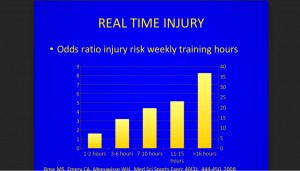 Risk of injury increases precipitously with increased weekly training hours.
- Training more than 8 months out of the year is associated with a significant increase in all knee injuries, overuse injuries, and hip injuries.
- Burn out occurs and athlete mental well-being drops off with > 14 hrs/wk sports due to training stress, non-training stress and insufficient recovery time. Athletes report: reduced intrinsic motivation, lack of enjoyment, poor or ineffective coping skills, high perceived stress/anxiety and mood disturbance. Fun goes missing.

Opportunity Lost: the hidden cost kids are paying
- Other sports and activities they don’t get to try
- Other growth patterns that don’t develop
- Other ways of problem-solving that aren’t introduced
- Other muscles and movement that is untried, unproven, untapped
- Other talents that go undiscovered
Family costs: the cost we absorb and don’t always admit
- Family time
- Family $$$
- Marital relationships
- Time balance among siblings
- Sibling rivalry and competition
When is the time to have the “is it wise to specialize” conversation?
Pediatricians measure the rate of “peak height take off” in our kids. This is when puberty kicks in and their growth sky rockets. The average onset in boys is 11 years and in girls is 9 years. The peak height velocity (PHV): avg for boys 13.5 yrs, avg for girls 11.5 years. Peak weight gain for boys is the same as their PHV but in girls it is 6 months later. *
PHV correlates with many characteristics which correspond with sports performance:
- Total body balance
- Limb movement speed
- Trunk strength
- Explosive strength
- Cardio resp endurance
- Upper body musc
- Running speed
- Agility
- Anaerobic capacity
This means the time to have the conversation about costs and benefits of sports is before puberty. Before coaches are scouting them and wooing them to “select” teams because of their physical prowess and promising college and professional careers, talk about what is healthy, what is good for them and what is good for the family. Have the conversation along with the pediatrician at the child’s pre-pubertal check-up.
How to have the ‘How much sport is good for you?’ conversation
Here are questions Dr. LaBotz uses with her patients and their families. She highlights the important information she gets from both verbal and non-verbal responses. The answers to these questions deserve careful consideration and a check against what is healthy for the child.
- What sports do you play? What seasons? How many training years in each?
- Are you a specialist or sampler? (single or multi-sport?)
- How much time (or mileage, for runners) do you put in?
- How many days of rest do you get per week?
- When’s your off season?
- Are you having fun? (Notice the verbal and non-verbal response).
- How does it feel to be the parent? (Notice the response and reaction.)
- What are your goals in sport? (current season, next level, ultimate goals)
This conversation presents the perfect opportunity to broach the details, provide the facts, to address hopes and dreams but also to present the realities of sports opportunities. It opens the door to weigh the benefits and the costs, even the hidden ones. Dr. LaBotz reminds her peers:
“It’s the pediatrician’s job to help their patients pursue sports in the right amount so it provides a foundation for lifetime engagement in a healthy level of physical activity for optimal health, optimal fitness and optimal function as well as enjoyment and athletic achievement.”
Researchers and doctors are telling us that too much of one sport too early is NOT good for our kids and won’t help them fare well in the future. We’ve got to establish a new social and cultural norm in kids sports: Say No to kids playing one sport for 11 months of the year. It hurts them physically, mentally and emotionally, and it doesn’t pay long term dividends. Yes, they love soccer (or basketball or baseball or volleyball) but binge-playing is as bad as binge-eating. Let’s keeping them sampling and choosing between sports for as long as we can.
As John O’Sullivan so aptly puts it: “Next time I hear, “My seven-year-old only plays soccer because that is all he wants to do” I will say, as I always do, “and my seven-year-old only wants to eat macaroni and cheese. But I don’t allow that because I know it’s not good for him. And I am the adult, and I am supposed to know better.”
Plus, kids don’t know what they’re missing. They can’t. They haven’t seen it. If you need help having this conversation, call on your pediatrician. Teaching our kids to say no to too much, too soon, starts with parents learning to say no to too much, too soon.
We’re the parents. We know better.
*The observation that, in girls, growth in weight and musculature lags 6 months behind growth in height means that special care should be taken to prevent injury during this fragile developmental time for girls. (average age 11-12 years)